 Book a Home Trial


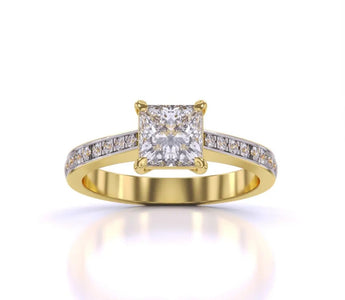
A princess cut diamond is a square (or very slightly rectangular) brilliant-cut diamond with four sharp, pointed corners and a pyramid-shaped underside. It gives a crisp, modern look with strong sparkle, usually costs less per carat than a round diamond of the same grade, and suits engagement rings and stud earrings well, provided the four corners are protected by the setting.
In this guide:
- What a princess cut diamond is and how it differs from round, cushion and radiant shapes
- Pros and cons, including the corner-chipping question
- The specifications to check on the certificate: ratio, table, depth, girdle, polish and symmetry
- How big a princess cut looks face-up compared with a round diamond
- Which settings protect the corners, plus a step-by-step buying checklist
- Common mistakes, how Ivana can help, and FAQs
What Is a Princess Cut Diamond?
Seen from the top, a princess cut is a square with sharp, unclipped corners. Seen from the side, it looks like an inverted pyramid. The facets on the pavilion (the lower half) are arranged as a series of chevron-like patterns, which break light into lots of small, lively flashes rather than the broad "hall of mirrors" look of step cuts such as emerald or Asscher.
It is classed as a "modified brilliant" because it uses brilliant-style faceting on a square outline. The shape became popular from the 1980s onwards and is now one of the most requested fancy shapes after round and oval. If you are comparing every shape side by side, our diamond shape guide is a good starting point; this article goes deep on the princess cut only.
Lab-grown princess cuts are cut exactly the same way as mined ones. A lab-grown diamond is chemically, physically and optically a real diamond, so everything below about light, proportions and durability applies equally. You can read more about how they are made on our lab-grown diamonds page.
Princess Cut vs Other Popular Shapes
Most buyers who like the princess cut are also looking at round, cushion, radiant and emerald shapes. The table below compares them on the points that usually decide the choice.
| Feature | Princess | Round brilliant | Cushion | Radiant | Emerald |
|---|---|---|---|---|---|
| Outline | Square, sharp corners | Circle | Square or rectangle, rounded corners | Square or rectangle, clipped corners | Rectangle, clipped corners |
| Facet style | Brilliant (sparkly) | Brilliant (maximum sparkle) | Brilliant (soft, chunky flashes) | Brilliant (very lively) | Step cut (calm, glassy flashes) |
| Corner durability | Most vulnerable; needs corner protection | No corners | Good | Good (corners clipped) | Good (corners clipped) |
| Hides inclusions | Well | Well | Well | Very well | Poorly; clarity shows |
| Face-up size per carat | Looks smaller than round across the sides, larger corner to corner | Benchmark | Often looks slightly smaller | Similar to princess | Looks larger for its weight |
| Cost per carat (same grade) | Usually lower than round | Highest | Usually lower than round | Usually lower than round | Usually lower than round |
| Best for | Modern solitaires, studs, men's rings | Classic solitaires | Vintage-style rings | Sparkle with fewer chip worries | Minimal, art deco looks |
The quick takeaway: if you love the square, geometric look but worry about sharp corners, a radiant cut gives a similar outline with clipped corners. If you want the crisp points, choose a princess and pick the setting carefully.
Pros and Cons of a Princess Cut Diamond
Why people choose it
- Strong sparkle. The brilliant-style pavilion produces lively light return, close to a round diamond when well cut.
- Better value per carat. A square outline uses more of the original crystal than a round, so less material is lost during cutting. That is why princess cuts are usually priced below rounds of the same carat, colour and clarity.
- Modern, clean lines. The square shape looks sharp in solitaires, side-by-side in eternity bands and in men's rings.
- Forgiving on clarity. The busy facet pattern helps mask small inclusions, so you rarely need a very high clarity grade for an eye-clean stone.
What to watch for
- Corner chips. The four pointed corners are the most exposed part of the stone. Diamond is extremely hard but can still chip along its cleavage planes if a sharp corner takes a knock. The Gemological Institute of America explains in its article on how to protect a diamond from chipping that pointed shapes benefit from settings that cover the corners.
- Colour in the corners. The deep pavilion can concentrate a hint of warmth at the corners in lower colour grades, so princess cuts often look best one grade higher in colour than you would accept in a round.
- Dirt shows. The flat table and sharp outline can show grease and dust quickly; regular cleaning keeps the sparkle crisp.
How to Read a Princess Cut on the Certificate
For fancy shapes such as the princess, grading labs often do not give a single overall "cut grade" the way they do for rounds. That puts more weight on the individual measurements. Ivana's lab-grown diamonds come with IGI or SGL certification, and you can check any report on the lab's website, for example through the report check on the IGI website. Our IGI certificate explained guide walks through every line; for a princess cut, these are the lines that matter most.
| Report line | What it tells you | Commonly recommended range |
|---|---|---|
| Measurements (length x width x depth) | Divide length by width to get the ratio | Ratio about 1.00 to 1.05 for a square look |
| Table % | Width of the top flat facet relative to the stone | Roughly 67% to 72% |
| Depth % | Total depth relative to width | Roughly 64% to 75% |
| Girdle | Thickness of the outer edge | Thin to slightly thick; avoid "extremely thin" at the corners |
| Polish and symmetry | Finish quality and facet alignment | Very Good or Excellent |
| Culet | The bottom point | None or pointed is normal for princess cuts |
These ranges are general industry guidance rather than a single official standard, so treat them as a starting point and judge the stone by eye as well. A princess cut that is too deep will look small for its weight; one that is too shallow can show a dull or "windowed" centre.
How Big Does a Princess Cut Look?
Because weight is distributed into the deep pavilion and the corners, a princess cut measures less across its sides than a round diamond of the same carat measures across its diameter. However, the corner-to-corner diagonal is longer than the round's diameter, so on the hand it can look as large or larger, especially when set on point (rotated 45 degrees, like a diamond on a playing card).
Some practical examples of how this plays out:
- On a slim finger (around Indian ring size 8 to 10): a 1 ct princess set square covers much of the finger width, and its straight edges make the finger look slender. A 2 ct princess will reach close to the edges of the finger and reads as a bold statement.
- On a wider finger (around Indian size 16 and above): a 1 ct princess looks neat and understated. Many buyers here move to 1.5 ct or 2 ct, or set the stone on point so the diagonal runs along the finger.
- In stud earrings: princess studs show more surface than round studs of the same weight when viewed from the front, and the square outline looks crisp next to short hair or with formal wear.
For exact millimetre sizes by carat, see our diamond carat size chart in mm, and try stones on in person if you can, because finger shape and band width change how size reads.
Best Settings for a Princess Cut Diamond
The single most important decision is protecting the four corners. These are the options, from most to least protective.
- Bezel or half-bezel: a metal rim wraps the edges. Excellent protection and a sleek look; slightly less light enters from the sides.
- V-prongs (chevron prongs): four V-shaped claws cup each corner. The classic choice for princess solitaires because they guard the corners while keeping the stone open to light.
- Double or split prongs at each corner: eight small claws, two per corner, with a lighter look than V-prongs.
- Channel setting: used for princess cuts in bands and eternity rings; stones sit between two metal walls with corners tucked in.
- Standard round claws: fine for small accent stones, but for a centre stone ask whether the claws sit over the corners rather than the sides.
Princess cuts also look striking in halo designs, where a frame of small diamonds around the centre adds size and some side protection. Our guide to diamond setting types explains each option in more detail.
Metal colour matters too. White gold keeps a high-colour princess looking icy; yellow or rose gold can make a slightly warmer stone look intentional. Ivana sets diamonds in BIS hallmarked 9kt, 14kt and 18kt gold. You can browse ready designs in our princess cut diamond rings collection or compare them with other shapes across our diamond engagement rings.
Step-by-Step Checklist for Buying a Princess Cut
- Decide the look: square-set or on point, solitaire or halo, ring or studs.
- Set your priorities: many buyers choose good cut proportions first, then colour around G to H, then clarity that is eye-clean (often VS2 to SI1 in a princess), then carat.
- Check the ratio: divide length by width on the certificate; aim for about 1.00 to 1.05 if you want a true square.
- Check table, depth and girdle: compare with the ranges above and avoid "extremely thin" girdles.
- Look at the corners: under a loupe or the jeweller's microscope, make sure there are no existing nicks.
- Confirm the setting covers the corners: V-prongs, split prongs, bezel or channel.
- Verify the certificate online: match the report number (and inscription, if present) to the lab's database.
- Review the price breakup: on Ivana product pages you can see how diamond, gold and making charges add up at today's gold rate.
- Understand after-sales terms: buyback, exchange and return policies before you pay.
Questions to ask in-store
- Can I see the stone loose or under magnification before it is set?
- Which prong style protects the corners on this design, and can it be changed?
- Can I compare the same carat weight in princess, round and radiant side by side?
- How often should the claws be checked, and is cleaning and inspection available at the showroom?
Common Mistakes to Avoid
- Buying on carat alone. A deep princess can weigh more yet look smaller than a better-cut, lighter stone.
- Ignoring the corners. A thin-claw setting that sits on the sides leaves the points exposed to knocks.
- Accepting a "rectangular" stone by mistake. A ratio above about 1.08 starts to look noticeably rectangular; fine if you like it, disappointing if you expected a square.
- Going too low on colour. Warmth gathers in the corners, so dropping colour grade can show more than in a round.
- Skipping maintenance. Wear on claws is gradual; a quick check every few months prevents a lost or chipped stone.
How Ivana Can Help
Ivana Jewels designs lab-grown diamond jewellery certified by IGI or SGL, set in BIS hallmarked gold, with Lifetime Buyback and Exchange and 7-day free returns on online orders. If you are deciding on a princess cut:
- Visit a showroom: with 16 showrooms across India, you can compare princess, round and radiant stones on your own hand. Find the nearest one on our store locator.
- Book a virtual appointment: if you live abroad or cannot visit, you can book an appointment and see designs on video.
- Customise: change the prong style, metal colour, band width or carat on many designs, or add a halo.
- Check the live price breakup: every product page shows how the price is built up, so you can compare carat and gold options transparently.
Prefer earrings? Princess studs are also available in our solitaire earrings collection.
FAQs
Is a princess cut diamond good for an engagement ring?
Yes. It offers strong sparkle, a modern square look and usually better value per carat than a round. The key is a setting that protects all four corners, such as V-prongs or a bezel.
Do princess cut diamonds chip easily?
They are not fragile, but the pointed corners are their most exposed area. With protective prongs, a sensible girdle thickness and regular claw checks, chipping is uncommon in everyday wear.
Does a princess cut look bigger than a round diamond?
Across the sides it measures slightly less than a round of the same carat, but its diagonal is longer. Set on point, many people find a princess looks as large as or larger than a round of the same weight.
What is the best colour and clarity for a princess cut?
Many buyers choose colour around G to H and an eye-clean clarity, often VS2 to SI1, because the facet pattern hides small inclusions. Colour shows slightly more in the corners, so going one grade higher than you would in a round is a common choice.
What is the difference between princess and radiant cut?
Both are square or rectangular brilliant cuts. A princess has sharp, pointed corners; a radiant has clipped (cut-off) corners, which makes it less prone to corner damage and gives a slightly different sparkle pattern.
Are lab-grown princess cut diamonds real diamonds?
Yes. Lab-grown diamonds have the same chemical, physical and optical properties as mined diamonds and are graded the same way. Ivana's lab-grown diamonds are certified by IGI or SGL.


