 Book a Home Trial


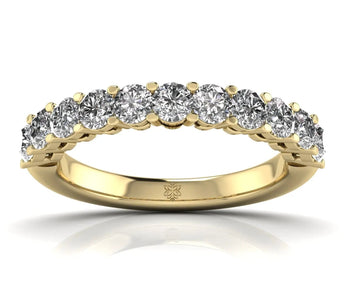
A diamond engagement band is an engagement ring with no raised centre stone: the diamonds run along the band itself, usually across the top half (a half eternity) or all the way round (a full eternity). It is a good choice if you want a ring that sits low, suits everyday work and can be worn alone or stacked later. A classic solitaire still makes more sense if you want a single larger stone to be the focus.
In this guide:
- What counts as a diamond engagement band
- Engagement band vs solitaire: a side-by-side comparison
- Half, three-quarter or full eternity: which works for an engagement
- Settings, stone shapes and metals explained
- A step-by-step checklist before you buy
- Common mistakes to avoid
- How Ivana can help, and FAQs
What Is a Diamond Engagement Band?
Most engagement rings are built around one raised centre diamond. An engagement band turns that idea on its side. Instead of one stone held up by prongs, a row of matched diamonds is set into the band so the sparkle spreads across the finger rather than sitting in one point.
The term covers a few related styles:
- Half eternity band: diamonds across the top half of the ring, with plain metal underneath. This is the most common choice for an engagement.
- Three-quarter eternity band: diamonds across roughly three quarters of the ring, leaving a short plain section at the bottom.
- Full eternity band: diamonds all the way round, with no plain section.
- Statement or wide band: two or more rows of diamonds, or larger stones such as ovals, emeralds or baguettes set east-west across the finger.
The circle has long been read as a symbol of a love with no beginning and no end, which is why so many couples feel an all-diamond band carries the same meaning as a traditional engagement ring. You can browse the full range of styles in our diamond band rings collection to see how different each one looks on the hand.
Engagement Band vs Solitaire: The Real Differences
Choosing between a band and a solitaire is less about which is "better" and more about how the ring will be worn day to day. The table below sets out the practical differences.
| Factor | Diamond engagement band | Solitaire engagement ring |
|---|---|---|
| Where the sparkle sits | Spread across the top of the finger | Concentrated in one centre stone |
| Profile on the hand | Low; rarely catches on gloves, hair or knitwear | Raised; the centre stone sits higher above the finger |
| Everyday practicality | Suits typing, cooking, gym and hands-on jobs | Needs a little more care with knocks |
| Total carat weight | Made up of many smaller stones (stated as total carat weight) | Mostly in one stone, so the centre carat is larger |
| Certification | Larger individual stones can carry their own report; small melee stones are usually graded as a matched set | The centre diamond normally has its own grading report |
| Resizing | Half eternity: usually possible within limits. Full eternity: often not possible | Usually straightforward |
| Pairing with a wedding band | Sits flush and stacks easily | May need a curved or notched band to sit flush |
| Works alone? | Yes; many people never add a second ring | Yes, but often paired with a band after the wedding |
If you like both looks, there is a middle ground: a solitaire on a diamond-set shank. We compare that option in detail in our guide to choosing a solitaire with a pavé or plain band.
Half, Three-Quarter or Full Eternity: Which Suits an Engagement?
Half eternity: the practical favourite
Diamonds sit only on the part of the ring people actually see. The plain underside is more comfortable between the fingers, and it leaves metal that a jeweller can work with if the size ever needs adjusting. From above, a half eternity looks almost identical to a full eternity.
Three-quarter eternity: more sparkle when the hand turns
This adds diamonds down the sides so the ring still shows sparkle when the hand is held sideways, while keeping a short plain section for comfort and limited resizing.
Full eternity: maximum sparkle, least flexibility
A continuous circle of diamonds is the most striking option and the most symbolic, but the ring size must be right from day one. Because there is no plain metal to cut or add to, most full eternity rings cannot be resized in the usual way, and the stones on the underside can press against neighbouring fingers. Our diamond eternity ring buying guide explains the construction in more depth.
Quick rule of thumb
- Not completely sure of the ring size, or fingers swell in summer? Choose a half eternity.
- Want sparkle from every angle and know the size is right? Consider three-quarter or full.
- Planning to add a wedding band later? A half eternity stacks most comfortably.
Settings, Stone Shapes and Metals Explained
Setting styles
- Claw (prong) set: small claws hold each stone, letting in the most light. Very bright, but claws should be checked periodically.
- Shared-claw or French pavé: neighbouring stones share claws, so the diamonds look almost continuous.
- Channel set: stones sit between two metal walls. Smooth to the touch and well protected, with slightly less light around the edges.
- Bezel set: a thin rim of metal surrounds each stone. The most protective and modern-looking option.
- Micro-pavé: very small stones close together for a fine, glittering surface; more delicate and not ideal for heavy resizing.
Stone shapes
Round brilliants give the most sparkle. Ovals and pears set east-west look wider and modern. Emerald and baguette cuts create a clean, step-cut "hall of mirrors" look. Princess cuts give a crisp, geometric line. Whatever the shape, the stones should be matched closely in colour and size so the band looks even from end to end.
Metal and purity
Engagement bands are usually made in 14kt or 18kt gold, in yellow, white or rose. 18kt has a richer colour, while 14kt is slightly harder-wearing for daily use. All Ivana gold is BIS hallmarked (9kt, 14kt or 18kt); you can check how hallmarks and HUID numbers work on the Bureau of Indian Standards hallmarking page.
How Big Should the Stones Be? Concrete Examples
With a band, the look depends on the size of each stone and how far the stones run around the ring. A few examples help:
- A slim band of very small round stones reads as a fine line of light. It suits petite fingers and anyone who wants a quiet, everyday ring, and it pairs neatly with a later wedding band.
- A medium band of slightly larger rounds or ovals is visible from across a room, yet still sits low enough for office work. On a larger finger it looks balanced rather than thin.
- A band of larger emerald-cut or oval stones becomes the statement itself. Because each stone is bigger, ask whether the larger stones carry their own grading reports.
As a general guide, wider bands look in proportion on longer or larger fingers, while slim bands lengthen shorter fingers. If you can, try two widths side by side before deciding.
Lab-Grown Diamonds in Engagement Bands
Because an engagement band uses many stones, the quality has to be consistent across all of them. Lab-grown diamonds have the same chemical, physical and optical properties as mined diamonds, which makes it practical to match colour and clarity closely across a full row. You can read how they are made and graded on our lab-grown diamonds guide.
Ivana's diamonds are certified by IGI or SGL. For larger individual stones, ask to see the report and check the report number online on the IGI report verification page. For bands made of many small stones, the product page lists the total diamond weight, and the price breakup on each product page shows how the diamond and gold components add up.
Step-by-Step Checklist Before You Buy
- Confirm the ring size properly. Measure at the end of the day, when fingers are at their largest, and check the knuckle as well. Our ring size chart for India converts US and Indian sizes.
- Choose coverage. Half, three-quarter or full eternity, based on how sure you are of the size and how much side sparkle you want.
- Pick the setting. Claw or shared-claw for brightness; channel or bezel for an active lifestyle.
- Check stone matching. Look at the band under daylight and store lighting. No single stone should look yellower, smaller or duller than its neighbours.
- Check the finish. Run a finger along the band. Claws should not snag, and the underside should be smooth.
- Read the paperwork. Note the total diamond weight, metal purity and hallmark, and certification for any larger stones.
- Think about the wedding band now. Try the engagement band with a plain or diamond band beside it to see whether the two sit flush.
- Ask about aftercare. Ask how often the setting should be checked and how cleaning, exchange and buyback work.
What to Ask in the Store
- Is this a half, three-quarter or full eternity, and can it be resized?
- What is the total diamond weight, and how many stones are there?
- Which setting holds the stones, and how often should it be checked?
- Are the larger stones individually certified by IGI or SGL?
- Can I see it beside a matching wedding band?
- Can the design be customised in a different width, stone shape or gold colour?
Common Mistakes to Avoid
- Buying a full eternity on a guessed size. If the proposal is a surprise, a half eternity is far safer.
- Judging only from the top. Turn the hand sideways and check how the ring looks and feels between the fingers.
- Ignoring stone matching. One off-colour stone in a row is more noticeable than in a cluster.
- Choosing micro-pavé for very hands-on work. A channel or bezel setting will cope better with daily knocks.
- Forgetting the wedding band. A very wide engagement band can make a later stack feel heavy. Plan the pair together. Our guide to the difference between an engagement ring and a wedding ring explains how couples in India usually wear both.
- Comparing only total carat weight. Two bands with the same total weight can look very different depending on stone size, cut and setting.
How Ivana Can Help
You can see engagement bands and solitaires side by side at any of our 16 showrooms. Find the nearest one on the Ivana store locator. If you are abroad or cannot visit, book a virtual appointment and a consultant can show you bands on camera, compare widths and settings, and talk you through sizing.
Many bands can be customised in stone shape, width or gold colour. Each product page carries a full price breakup, so you can see how the gold and diamond components make up the total. If you still prefer a raised centre stone after comparing, our diamond engagement rings collection covers solitaires, halos and three-stone designs. For a continuous circle of diamonds, explore our eternity rings.
Every Ivana piece is set in BIS hallmarked gold, is certified by IGI or SGL, and comes with Lifetime Buyback & Exchange. Online orders also have a 7-day free return window.
FAQs
Can a diamond band be used as an engagement ring?
Yes. There is no rule that an engagement ring must have a centre stone. A diamond band carries the same meaning and is increasingly chosen by people who want a low, practical ring they can wear every day.
What is the difference between an engagement band and a wedding band?
The difference is mainly when and why it is given. An engagement band is given at the proposal or engagement, and a wedding band is exchanged at the wedding. Some people wear one diamond band for both; others add a second band later and wear them stacked.
Is a half eternity or full eternity better for an engagement ring?
For most people a half eternity is the more practical choice. It is more comfortable, usually resizable within limits, and looks almost the same as a full eternity from above. Choose a full eternity only when you are confident of the ring size.
Can an eternity engagement band be resized?
A half eternity can usually be resized slightly because the underside is plain metal. A full eternity generally cannot be resized in the normal way, because diamonds run all the way round. Confirm the limits with the jeweller before buying.
Do the small diamonds in a band come with a certificate?
Very small stones are normally graded as a matched set rather than individually. Larger stones can carry their own report. Ivana's diamonds are certified by IGI or SGL, and the product details show the total diamond weight.
Which setting is best for an everyday engagement band?
Channel and bezel settings protect the stones best and feel smooth. Claw and shared-claw settings show more sparkle but are worth having checked by a jeweller from time to time.
Can I wear a diamond engagement band with a solitaire later?
Yes. Many people later add a solitaire or a second band and wear them stacked. Try the combination in store first so the rings sit comfortably together.


