 Book a Home Trial


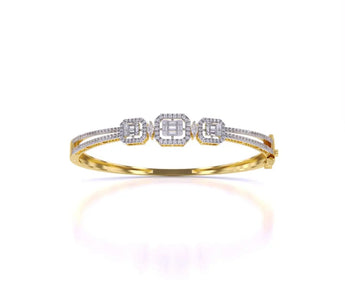
A lab grown diamond bangle is a rigid gold bangle set with laboratory-grown diamonds, which have the same chemistry, hardness and sparkle as mined diamonds. To choose the right one, decide first between a slip-on and an openable design, size it from your hand rather than your wrist, pick a setting that suits how often you will wear it, and check the gold hallmark and the diamond certificate before you buy.
In this guide:
- What a lab grown diamond bangle is (and how it differs from a bracelet or kada)
- Slip-on, openable or cuff: the first decision
- Getting the size right
- Diamond settings and layouts for daily wear and occasions
- Choosing the gold: 9kt, 14kt or 18kt
- How to read a bangle product page and certificate
- Single bangle, pair or stack
- A step-by-step buying checklist and common mistakes
- Care, and how Ivana can help
- FAQs
What is a lab grown diamond bangle?
A bangle is a rigid ring of metal worn on the wrist. Unlike a bracelet, it has no flexible links; unlike most chain bracelets, it keeps its round or oval shape on and off the wrist. A diamond bangle adds stones along the top, part of the way round, or all the way round the band.
The diamonds are real diamonds, grown in a laboratory by the CVD or HPHT process instead of being mined. Our page on what lab-grown diamonds are explains the science in more detail.
Three words get used loosely in Indian jewellery shops, so it helps to separate them:
- Bangle: a rigid circle, usually slipped over the hand, often worn in pairs or stacks.
- Kada: a heavier, often wider bangle, which in modern designs usually opens on a hinge or screw.
- Bracelet: flexible, with links or a line of stones and a clasp, sized to the wrist.
Slip-on, openable or cuff: the first decision
How the bangle goes on affects its size, its comfort, how securely it stays on, and even which designs are possible. Decide this before you look at diamonds.
| Type | How it goes on | Sized to | Strengths | Watch out for |
|---|---|---|---|---|
| Slip-on (closed) bangle | Squeezed over the knuckles | The closed hand | No hinge or clasp to wear out; classic for pairs and bridal stacks | Moves and spins on the wrist; cannot be resized once diamond-set |
| Hinged openable bangle or kada | Opens on a hinge, closes with a box clasp or push catch | The wrist (usually one to two sizes smaller) | Closer, neater fit; allows wider and heavier designs; easy to put on | Check the clasp has a safety catch and closes with a firm click |
| Screw-open kada | A screw or pin is removed to open one side | The wrist | Very secure once closed | Slower to take off; small screws can work loose and need checking |
| Open cuff | Slides on sideways through a gap | The wrist | Some flexibility in fit; modern look | Bending the cuff repeatedly to adjust it can stress the stone settings |
As a rule of thumb, choose a slip-on bangle if you want a traditional pair or a stack with your existing gold bangles, and an openable design if you want one diamond piece you can wear every day without it sliding down to your hand. If you are drawn to the bolder, wider look, browse lab grown diamond kada bracelets, which are mostly openable.
Getting the size right
Indian bangle sizes such as 2.4 and 2.6 describe the inside diameter: the first figure is 2 inches and the second adds sixteenths of an inch. Size 2.6 is 60.3 mm across the inside and about 19 cm around, and is the most common size for adult women. Our bangle size chart and calculator gives every size in mm, cm and inches.
The rules that matter most for a diamond bangle:
- Slip-on bangles are sized to the closed hand, not the wrist. Bring your thumb towards your little finger and measure around the knuckles.
- Openable bangles and kadas sit closer to the wrist, so they usually run one to two sizes smaller. Always follow the size note on the product page.
- Wide or heavy bangles feel tighter than slim ones of the same size. Consider the next size up for a broad bridal piece.
- Diamond-set bangles usually cannot be resized, because the setting runs around the band. Measure before you order.
Example: if your hand measures 18.9 cm around the knuckles, a slip-on bangle in size 2.6 (about 19 cm around) will just clear your hand. The same person will typically be a 2.4 in a hinged kada, because that kada never has to pass over the knuckles.
Diamond settings: what suits daily wear and what suits occasions
The setting is the metalwork that holds each diamond. On a bangle it matters more than on a ring or earring, because the outer edge of a bangle knocks against desks, car doors and kitchen counters all day.
| Setting | What it looks like | Sparkle | Daily-wear durability | Suits |
|---|---|---|---|---|
| Prong (claw) | Each stone held by small metal claws | High: more light enters the stone | Moderate: claws can catch on fabric and bend | Occasion and evening wear |
| Pavé / micro-pavé | Many small stones set close together with tiny beads of metal | High, carpet-like shimmer | Moderate: small stones can loosen with hard knocks | Statement and bridal bangles |
| Channel | Stones held between two metal walls | Good | High: no exposed edges | Everyday and office wear |
| Bezel | A metal rim surrounds each stone | Good, with a smooth outline | Very high: the most protective | Daily wear and active lifestyles |
| Bar | Stones separated by thin vertical bars | High, open on the sides | Good | Eternity-style bangles |
The more metal around each stone, the more protected it is and the less light reaches it from the sides.
Diamond layout: all the way round or only on top?
- Full eternity (stones all the way round): sparkles from every angle and looks the same however the bangle turns. The stones underneath take the most knocks and press against your wrist when you type or write.
- Half eternity or top-set: stones only on the visible upper half. More comfortable for desk work, and the underside of plain gold protects the stones from wear.
- Motif or station designs: a single cluster, bow, floral or geometric centre, or stones spaced at intervals. Lighter, easier to stack, and often the most practical daily choice.
A hinged bangle stays the right way up, so top-set layouts suit it; a slip-on bangle rotates, which is why full eternity is common on slip-on styles.
Choosing the gold: 9kt, 14kt or 18kt
The karat tells you how much pure gold is in the alloy. Lower karat gold contains more alloy metals, which makes it harder and more scratch-resistant; higher karat gold is richer in colour and contains more gold.
| Karat | Gold content | Hardness and wear | Colour | Suits |
|---|---|---|---|---|
| 9kt | 37.5% | Hardest of the three, resists scratches and dents | Paler yellow | Lightweight everyday bangles |
| 14kt | 58.5% | Strong and durable | Warm yellow; also white and rose | A balance of daily wear and richness |
| 18kt | 75% | Softer; shows scratches sooner | Deepest yellow; also white and rose | Bridal and occasion pieces, heirloom bangles |
Whatever the karat, the bangle should carry a BIS hallmark: the BIS logo, the purity grade (for example 18K750 or 14K585) and a six-character HUID code you can check in the BIS CARE app. Our guide to the BIS hallmark and HUID on gold jewellery shows exactly where to look, and the Bureau of Indian Standards publishes the official rules.
How to read a bangle product page
Bangles are priced on gold weight, diamond weight and quality, and making charges, which is why a broad bangle with fewer diamonds can cost more than a slim one with many. On Ivana product pages the live price breakup shows each part separately. These are the figures to look at:
- Gold weight (net): the weight of the gold alone, in grams. Heavier gold means a sturdier bangle but more weight on the wrist.
- Total diamond weight: the combined carat weight of all the stones. A bangle with 60 stones totalling 1.20 ct has an average of 2 cents (0.02 ct) per stone, so it will look like a fine line of sparkle rather than large individual diamonds.
- Number of stones: together with total weight, this tells you whether the design uses many small stones or fewer larger ones.
- Diamond colour and clarity: usually a range for all the stones. On small stones, colour matters more than clarity, because tiny inclusions are invisible at that size.
Certification for bangles: what to expect
A solitaire ring usually comes with a grading report for one stone. A bangle contains dozens of small diamonds, so the report covers the jewellery piece as a whole: total diamond weight, number of stones, the colour and clarity range, and confirmation that the diamonds are laboratory-grown. Ivana bangles are certified by IGI or SGL. Our guide to reading an IGI certificate walks through each line, and you can check any report number on the IGI website.
Single bangle, pair or stack?
- Single: the most versatile for daily wear, especially an openable design on the non-writing hand.
- Pair: traditional for weddings and festivals; usually slip-on and sized identically.
- Stack: a diamond bangle between plain gold bangles. Diamond can scratch neighbouring gold over time, so bezel or channel settings stack more kindly than prongs.
For style ideas, from slim minimal bands to bridal multi-row pieces, see our round-up of diamond bangle designs.
Step-by-step checklist before you buy
- Decide where you will wear it: every day, at work, or mainly at weddings and functions.
- Choose the closure: slip-on for pairs and stacks, hinged or screw-open for a close daily fit.
- Measure correctly: the closed hand for slip-on, the wrist for openable, in the evening when hands are slightly larger.
- Pick the setting to match your routine: bezel or channel for daily wear, prong or pavé for occasions.
- Choose the karat: 9kt or 14kt for hard-wearing everyday pieces, 18kt for richer colour.
- Read the price breakup: gold weight, total diamond weight, number of stones and making charges.
- Check the paperwork: BIS hallmark with HUID on the gold, and an IGI or SGL report that matches the piece.
- Read the return and exchange terms: because diamond bangles rarely resize, the return window matters.
Common mistakes to avoid
- Measuring the wrist for a slip-on bangle. It has to pass over the knuckles first, so it will not go on.
- Buying a prong-set statement bangle for daily office wear. The claws catch on sleeves and take knocks against desks.
- Comparing bangles on total carat weight alone. Sixty tiny stones and six larger ones can share the same total weight and look completely different.
- Stacking a diamond bangle tightly against soft 22kt gold bangles without expecting some scratching on the gold.
- Not checking the clasp. On an openable bangle, the clasp and hinge do most of the work of keeping it on your wrist.
Caring for a lab grown diamond bangle
Lab grown diamonds need the same care as mined ones. Take your bangle off for the gym, cleaning and swimming. Soak it in warm soapy water, brush gently behind the stones with a soft toothbrush and pat dry. Store it separately so the diamonds do not scratch other pieces. Tap it gently near your ear now and then: a faint rattle can mean a loose stone that needs a jeweller. On openable designs, check the hinge and clasp still close firmly.
How Ivana can help
You can browse our full range of lab grown diamond bangles, or the wider diamond bracelets and bangles collection, with a live price breakup on every product page showing gold, diamond and making charges separately. Every piece is set in BIS hallmarked 9kt, 14kt or 18kt gold with IGI or SGL certified lab grown diamonds, and is covered by our Lifetime Buyback and Exchange. Online orders come with 7-day free returns.
If you would rather try slip-on and openable styles side by side and be measured properly, find your nearest of our 16 showrooms on the store locator, or book an appointment so a consultant can show you designs in your size and talk you through customisation options.
FAQs
Are lab grown diamond bangles real diamonds?
Yes. Lab grown diamonds are made of crystallised carbon, just like mined diamonds, and have the same hardness and optical properties. The only difference is that they are grown in a laboratory. A reputable report from IGI or SGL will state that the stones are laboratory-grown.
Can I wear a diamond bangle every day?
Yes, if you choose a design built for it. A bezel or channel setting, a top-set or motif layout and 9kt or 14kt gold all stand up well to daily wear. Remove it for the gym, cleaning and swimming, and have the settings checked from time to time.
Should I choose a slip-on or an openable diamond bangle?
Choose slip-on for a traditional pair or a stack with gold bangles. Choose a hinged openable design for a closer fit that stays in place, which suits daily wear. Openable bangles usually run one to two sizes smaller.
What bangle size should I buy as a gift?
If you cannot measure, 2.6 is the most common adult women's size in India for slip-on bangles. For an openable bangle or kada, follow the size note on the product page. Check the return and exchange terms in case the size needs to change.
Do diamond bangles come with a certificate?
They should. Because a bangle holds many small stones, the report usually covers the whole piece, listing total diamond weight, number of stones and the colour and clarity range. Ivana bangles are certified by IGI or SGL, and the report number can be checked online.
Which gold karat is best for a diamond bangle?
For everyday wear, 14kt is a good balance of strength and colour, and 9kt is the most scratch-resistant. For bridal or occasion bangles where colour and gold content matter more, 18kt is the usual choice. Whatever you pick, look for the BIS hallmark and HUID.


