 Book a Home Trial


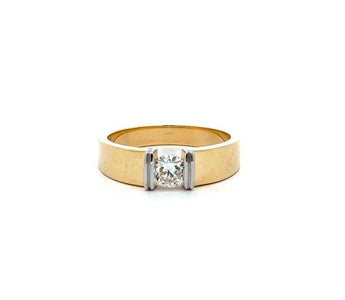
A hearts and arrows diamond is a round brilliant cut with such precise facet alignment that, seen through a special viewer, it shows eight symmetrical arrows from the top and eight hearts from the bottom. The pattern is proof of excellent optical symmetry, not a separate grade of diamond. It is worth paying a little more for if you want the most consistent round sparkle, but an Excellent cut round without the H&A label can look almost identical to the naked eye.
In this guide:
- What the hearts and arrows pattern is
- Why it happens: ideal cut and optical symmetry
- How to view it with an H&A scope
- Whether it appears on IGI or SGL reports
- Hearts and arrows vs Excellent cut
- Is it worth paying for? FAQs
What is the hearts and arrows pattern?
A modern round brilliant has 57 or 58 facets: 33 on the crown (top) and 24 or 25 on the pavilion (bottom). In most round diamonds those facets are close to, but not exactly, the same size and angle. In a hearts and arrows (H&A) diamond they are cut and aligned so precisely that a repeating pattern appears:
- Arrows: looking down through the table, you see eight evenly spaced arrow shapes radiating from the centre.
- Hearts: turning the loose stone upside down and looking through the pavilion, you see eight small, matching hearts, usually with a small "V" shape at the point of each.
The pattern only appears in round brilliants, because it depends on the eight-fold symmetry of that cut. If you are still deciding on a shape, our guide to the round diamond, the most popular diamond shape, explains why rounds dominate engagement rings.
Why it happens: ideal cut and optical symmetry
A cut grade on a report combines proportions (table size, crown angle, pavilion angle and depth), polish and symmetry. Symmetry on a report measures the outline and facet placement. Hearts and arrows goes further: it reflects optical symmetry, meaning the facets on opposite sides of the stone are matched so closely that their reflections line up.
To show crisp hearts and arrows, a round usually needs proportions in a narrow "ideal" band, broadly a table around 53 to 58 percent, a crown angle around 34 to 35 degrees and a pavilion angle around 40.6 to 41 degrees, plus Excellent polish and symmetry. Those are the same proportions that return a lot of light, so H&A stones tend to be bright, with an even pattern of sparkle when they move. For more on how facets shape light, read what diamond facets are and how they create brilliance.
The important nuance: H&A shows precision, not light performance on its own. A diamond can show a neat pattern and still have proportions that leak some light, and an excellent performer can show a slightly imperfect pattern. That is why you judge an H&A stone by its proportions and how it looks, not by the label alone.
How to view hearts and arrows
You cannot see the pattern clearly with the naked eye. You need an H&A viewer (also called a hearts and arrows scope), a small tube with a coloured or patterned reflector that isolates facet reflections.
- Arrows: place the diamond table-up and look down through the viewer. Count eight arrows; check they are the same length and evenly spaced.
- Hearts: this needs a loose stone. Turn it table-down and look through the pavilion. Check that the eight hearts are the same size and shape, with clefts and tips that line up.
- Look for faults: a heart with a split tip, hearts of different sizes, or arrows that twist are signs of small misalignments.
- Then look without the viewer: check the stone in normal light, ideally next to another round, because what you wear is the sparkle, not the pattern.
Once a diamond is set in a ring, you can still check the arrows, but the hearts are hard to see because the setting covers the pavilion. If H&A matters to you, ask to see the loose stone or its viewer images before it is set.
Is hearts and arrows on IGI or SGL reports?
Hearts and arrows is not part of the standard cut grade. Whether it appears on a report depends on the laboratory and the report type:
- The International Gemological Institute (IGI) offers a Hearts & Arrows report that can include images of the arrows and hearts patterns taken through a viewer, alongside the usual grading details.
- Some standard reports simply carry a comment such as "Hearts & Arrows" with no images. A comment alone tells you less than actual viewer images.
- Other reports do not mention H&A at all, even when the stone shows a good pattern.
Every Ivana Jewels diamond comes with an IGI or SGL report. Whether a particular stone carries an H&A note or images depends on that report, so if hearts and arrows is important to you, ask to see the report and, where possible, the stone in a viewer before you decide.
Hearts and arrows vs Excellent cut
| Feature | Excellent / Ideal cut round | Hearts and arrows round |
|---|---|---|
| What it means | Top cut grade on the report, based on proportions, polish and symmetry | An Excellent cut whose facets also align closely enough to show the H&A pattern |
| Shown on report | Always, as the cut grade for rounds | Only on some reports, as images or a comment |
| Optical symmetry | Good, but not necessarily precise | Very precise |
| Look to the naked eye | Bright, lively sparkle | Bright sparkle with a very even, balanced pattern |
| Availability | Common in lab grown rounds | Less common; takes more cutting time and loses more weight |
| Cost | Standard for top-cut rounds | Often a premium for the extra cutting work |
In short, every true H&A diamond is an excellent cut, but not every Excellent cut is H&A. Our guide on how to identify a well-cut diamond walks through the proportions and visual checks that matter for any round.
Is a hearts and arrows diamond worth paying for?
It depends on what you value:
- Worth it if: you are buying a round solitaire where the centre stone is the whole point, you enjoy the craftsmanship, or you want the most consistent sparkle from a round.
- Less important if: the stone is small (in studs or side stones, nobody will see the difference), it is a halo or cluster design where many stones combine, or you would rather put the budget into a slightly larger carat.
- Not relevant for: ovals, pears, princess, emerald and other shapes, which cannot show the pattern.
A sensible approach for most buyers is to insist on an Excellent cut grade for any round, and treat hearts and arrows as a bonus rather than a requirement. For the bigger picture of how cut sits next to colour, clarity and carat, see the 4Cs of diamonds explained.
Checklist: buying a round solitaire with great cut
- Choose a round brilliant with an Excellent cut grade, plus Excellent polish and symmetry.
- Check the table, crown and pavilion angles on the report against the ranges above.
- If the seller claims H&A, ask for viewer images or a look through a scope.
- Compare the stone side by side with another round in the same light.
- Verify the IGI or SGL report number on the laboratory's website.
- Pick a setting that lets light in: a four- or six-prong solitaire shows a round's sparkle best.
Ready to compare stones? Browse our solitaire rings or round engagement rings, and if you are still choosing between outlines, our diamond shape guide compares every popular cut.
How Ivana can help
Cut is easiest to judge in person. At any of our 16 showrooms (find the nearest on the store locator) you can compare round lab grown diamonds side by side, read their IGI or SGL reports with our team, and choose a setting. Product pages show a full price breakup, and every piece is set in BIS hallmarked gold with Lifetime Buyback and Exchange. New to the material? Start with our introduction to lab grown diamonds.
FAQs
Can lab grown diamonds have hearts and arrows?
Yes. Hearts and arrows comes from how a diamond is cut, not where it was grown. A lab grown round brilliant cut to precise ideal proportions and optical symmetry can show the same pattern as a mined one.
Can I see hearts and arrows with the naked eye?
Not clearly. You need an H&A viewer to isolate the reflections. Without one you see the result of that precision, an even and bright sparkle, rather than the hearts and arrows themselves.
Do other shapes have hearts and arrows?
No. The pattern depends on the eight-fold symmetry of a round brilliant. Some branded cuts show similar patterns in other shapes, but the classic hearts and arrows term applies to rounds.
Is hearts and arrows the same as an Excellent cut?
No. Excellent is the cut grade on the report. Hearts and arrows is an extra level of optical precision that only some Excellent cut rounds reach.
How do I know an H&A claim is genuine?
Ask for the report and look for actual viewer images or an H&A note from the laboratory, then check the stone through a scope yourself. A sales description alone is not proof.
Does hearts and arrows affect resale or buyback?
Buyback is usually based on the diamond's graded details such as carat, colour, clarity and cut, so ask how a specific policy treats a hearts and arrows note before you pay extra for it.


